
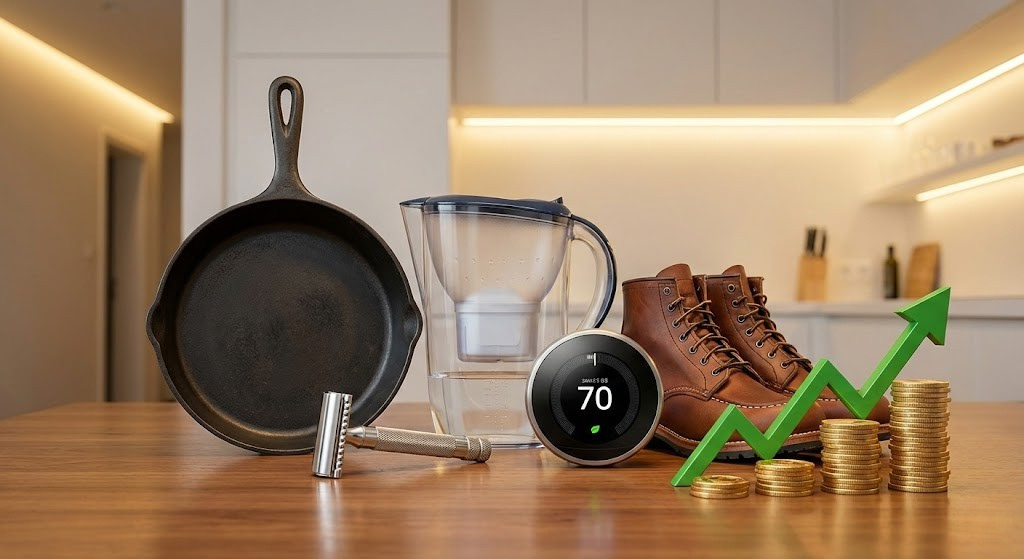
In the world of personal finance, there is a pervasive myth that frugality is synonymous with buying the cheapest possible version of everything. However, seasoned Frugal Living Enthusiasts understand a deeper truth: the “cheapest” option often represents a significant sunk cost that drains your bank account through frequent replacements, inefficiency, and wasted resources.
This is best illustrated by the “Vimes’ Boots Theory of Socioeconomic Unfairness.” In short, a person who can afford a $50 pair of high-quality boots that last ten years will spend far less over a decade than a person who can only afford $10 boots that wear out every season. The goal of this guide is to help you transition from the cycle of disposable consumption to a strategy of intentional investment. By focusing on durability, resourcefulness, and a high Return on Investment (ROI), you can build a household that actively generates wealth by plugging the small leaks in your budget.
The Philosophy of the Payback Period
Before we dive into specific products, we must establish the analytical framework used to evaluate an investment. Every purchase listed here is vetted based on its break-even point—the moment when the accumulated savings from using the product equal its initial purchase price. From that point forward, the product is essentially “paying” you to own it.
We prioritize items that offer functional excellence and structural integrity. We are not looking for visual flair; we are looking for tools that perform at a high level for years, if not decades.
The Kitchen: Turning Your Home into a Profit Center
The kitchen is often the site of the greatest household waste, both in terms of food spoilage and the recurring cost of disposables. By investing in professional-grade tools, you can leverage bulk buying and meal prepping to slash your grocery bill.

High-Quality Vacuum Sealer
Food waste is a silent budget killer. When you buy meat or produce in bulk to save money, much of it often ends up with freezer burn or spoiled before it can be consumed. A heavy-duty vacuum sealer removes oxygen, the primary catalyst for spoilage, extending the shelf life of frozen goods by up to five times.
- The Strategy: Use the sealer to portion out “Family Packs” of protein purchased at wholesale prices.
- The ROI: If you save $20 a month by avoiding food spoilage and buying in bulk, a $100 vacuum sealer pays for itself in just five months.
Cast Iron Cookware: The Ultimate BIFL Staple
Modern non-stick pans are designed with a built-in obsolescence. The chemical coatings eventually flake off, rendering the pan useless within 2-3 years. In contrast, a cast iron skillet is a Buy It For Life (BIFL) item. With proper seasoning, it develops a natural non-stick surface that improves with age.
- Durability: It is virtually indestructible. Even a rusted skillet found at a thrift store can be restored to like-new condition with minimal effort.
- Thermal Mass: Cast iron has superior heat retention, allowing you to cook more efficiently and achieve professional sears that make home-cooked meals more satisfying than expensive restaurant alternatives.
Silicone Food Huggers and Reusable Storage Bags
The recurring cost of aluminum foil, plastic wrap, and disposable zip-top bags adds up to hundreds of dollars over a lifetime. Transitioning to high-grade silicone alternatives (like Stasher bags) eliminates this recurring expense.
- Performance: Unlike flimsy plastic, quality silicone is oven-safe, dishwasher-safe, and airtight.
- Long-Term Savings: While a single silicone bag may cost $12, it replaces thousands of single-use plastic bags over its multi-year lifespan.
Digital Food Scale
Precision is the enemy of waste. A digital food scale allows you to follow recipes exactly, preventing the “measurement creep” that leads to using too many expensive ingredients. Furthermore, it is an essential tool for those who buy in bulk, allowing you to divide a 10-pound bag of flour or rice into perfect 1-pound portions for storage.
Energy and Utilities: Automating Your Savings
Utility bills are often viewed as fixed costs, but they are highly elastic based on the efficiency of your home’s hardware. Small, high-tech upgrades can yield massive annual savings.
LED Lighting Transition
If you are still using incandescent or even CFL bulbs, you are essentially burning money. LED bulbs use at least 75% less energy and last 25 times longer than incandescent lighting.
- The Math: An incandescent bulb costs roughly $7.00 per year to operate for 3 hours a day. An LED costs about $1.00. Across a house with 30 bulbs, that is a $180 annual saving.
- Lifespan: You won’t have to buy replacement bulbs for nearly a decade, further reducing your cost-per-use.
Smart Programmable Thermostats
Heating and cooling are the largest energy expenses for most households. A smart thermostat (like a Nest or Ecobee) uses sensors and algorithms to ensure you aren’t heating or cooling an empty house.
- Strategic Insight: By automatically adjusting the temperature by just 7-10 degrees for 8 hours a day (while you are at work), you can save up to 10% a year on heating and cooling.
- Break-even Point: Most users see the device pay for itself within 12 to 18 months through reduced utility bills.
Low-Flow Showerheads and Aerators
Reducing water usage has a dual benefit: it lowers your water bill and reduces the energy required to heat that water. Modern high-pressure, low-flow showerheads provide a satisfying experience while using significantly less volume.
- Efficiency: Older showerheads use 5.0 gallons per minute (gpm), while modern low-flow models use 1.5 to 2.0 gpm.
- Impact: For a family of four, this can save over 10,000 gallons of water annually.
Wool Dryer Balls
Fabric softeners and dryer sheets are chemical-heavy disposables that coat your clothes in a residue that actually reduces the absorbency of towels. Wool dryer balls are a one-time purchase that physically separate clothes in the dryer.
- Time Savings: They improve airflow, reducing drying time by 25%. This directly translates to lower electricity or gas consumption.
- Longevity: A set of quality wool balls can last for over 1,000 loads of laundry.
Personal Care: Eliminating the “Subscription” to Disposables
The personal care industry is built on the “razor and blades” business model: sell the handle for cheap and overcharge for the replacement cartridges. Breaking this cycle is a hallmark of the frugal lifestyle.

The Double-Edge Safety Razor
Safety razors are the gold standard for Cost-Per-Use. While a modern 5-blade cartridge can cost $4.00 to $5.00 per unit, a pack of 100 high-quality stainless steel safety blades can be purchased for $10.00 to $15.00.
- The Comparison: At 10 to 15 cents per blade, you can afford a fresh, sharp blade for every single shave, leading to less skin irritation and a significantly lower monthly spend.
- Build Quality: A solid brass or stainless steel safety razor handle is a long-lasting tool that will likely outlive the user.
High-End Hair Clippers
The “haircut tax” is a significant recurring drain. Even a basic $20 haircut once a month totals $240 a year. A professional-grade set of clippers (like those from Wahl or Oster) allows you to perform basic maintenance or full buzz cuts at home.
- Advanced Strategy: If you have children or a partner who prefers shorter styles, the savings compound. Learning to perform a “fade” or a simple trim via online tutorials is a high-value DIY skill.
Menstrual Cups and Period Underwear
For those who menstruate, the lifetime cost of tampons and pads is estimated to be between $2,000 and $6,000. A medical-grade silicone menstrual cup costs roughly $30 and can last up to 10 years with proper care.
- ROI: The product pays for itself within 3 to 6 months.
- Resourcefulness: Beyond the financial savings, it reduces environmental waste and the need to constantly monitor inventory.
Quality Water Filtration Pitcher or Under-Sink System
Bottled water is one of the most egregious examples of paying a premium for a basic commodity. It is often 2,000 times more expensive than tap water. A high-quality filtration system (using multi-stage carbon filters) provides clean, great-tasting water for pennies a gallon.
- Break-even: If you currently spend $5 a week on bottled water, a $30 filter pitcher pays for itself in six weeks.
Maintenance and Repair: Extending the Life of What You Own
Frugality isn’t just about what you buy; it’s about how you maintain what you already have. These tools prevent premature replacement of expensive goods.
Metal Tube Wringers
Think about how much toothpaste, expensive skin cream, or medicinal ointment stays trapped in the bottom of a tube. A heavy-duty metal tube wringer ensures you get 100% of the product you paid for. It is a simple mechanical tool that prevents roughly 10-15% of your tubed products from going into the trash.
Electric Fabric Shaver
Clothing often looks “old” or “worn out” not because the fabric is failing, but because it has developed “pills”—small balls of fiber. A fabric shaver removes these pills, reviving the look of sweaters, coats, and upholstery. This allows you to keep clothing in your rotation for years longer, delaying the need for new purchases.
Knife Sharpening Stone (Whetstone)
Dull knives are dangerous and make cooking a chore, often leading people to buy new, cheap knife sets. A quality dual-grit whetstone allows you to maintain a razor-sharp edge on your kitchen tools indefinitely.
- BIFL Mindset: Instead of buying a $50 set of “never-sharpen” knives every few years, buy one high-quality chef’s knife and a sharpening stone. You will have a superior tool that lasts a lifetime.
Advanced Strategy: The “Frugal Math” ROI Formula
To truly master the art of the “Spend to Save” philosophy, you must move beyond intuition and into calculation. Whenever you consider a higher-priced, high-quality item, apply the Payback Formula:
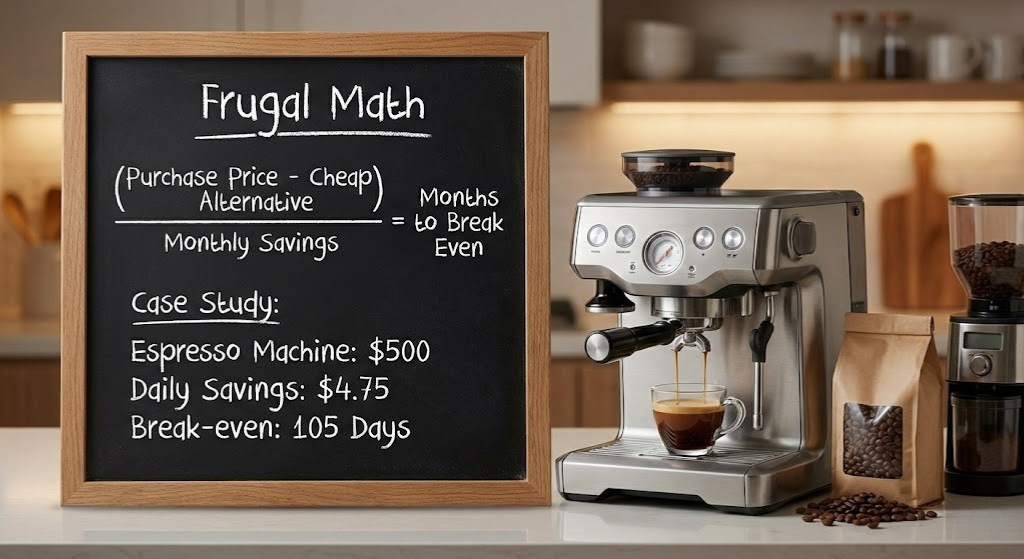
(Purchase Price of Quality Item – Price of Cheap Alternative) / Monthly Savings = Months to Break Even
Case Study: The Espresso Machine vs. The Daily Coffee Shop
Let’s look at a common high-ticket item: a semi-automatic espresso machine.
- Initial Investment: $500 (Machine + Grinder)
- Daily Cost of Coffee Shop: $5.50
- Daily Cost of Home Brewing: $0.75 (High-quality beans + milk + electricity)
- Daily Savings: $4.75
- Break-even Point: $500 / $4.75 = 105 Days
In just under four months, the machine has paid for itself. Over the next five years (assuming the machine lasts that long), the total savings exceed $8,000. This is the power of compounding “small” daily wins.
Common Mistakes and Pitfalls to Avoid
Even within the realm of high-ROI products, there are traps that can ensnare the unwary.
- The “Quality Trap”: Just because an item is expensive doesn’t mean it’s high quality. Always research the internal components and manufacturing origin. Look for “Full Grain” leather, “Forged” steel, and “Solid Wood” rather than marketing buzzwords.
- The Gadget Fallacy: Do not buy a tool for a job you don’t already do. If you don’t currently cook, a $300 Dutch oven won’t magically make you a chef; it will just be an expensive decoration.
- Ignoring the Secondary Market: For many BIFL items (like cast iron or high-end tools), the best ROI is found by buying them used. A used KitchenAid mixer for $100 is a much better investment than a new one for $400.
- Over-Maintenance: Some products require expensive specialized cleaners or accessories. Factor in the Total Cost of Ownership (TCO) before committing.
Implementation Checklist: Your 30-Day Action Plan
Ready to start building a more efficient household? Follow these steps:
- [ ] Week 1: The Energy Audit. Replace every frequently used incandescent bulb with an LED. Install low-flow aerators on your kitchen and bathroom sinks.
- [ ] Week 2: The Kitchen Overhaul. Inventory your disposables. Replace plastic wrap with silicone lids and start a “bulk-buy” list for your new vacuum sealer.
- [ ] Week 3: Personal Care Transition. Switch to a safety razor or menstrual cup. Calculate your monthly savings from these two items alone.
- [ ] Week 4: Maintenance Skills. Purchase a fabric shaver and a knife sharpener. Dedicate one hour to “reviving” your current wardrobe and kitchen tools.
Comprehensive FAQ
Q: Isn’t it risky to spend a lot of money upfront if I’m on a tight budget?
A: It can be. The key is to prioritize the items with the shortest Payback Period. Start with LED bulbs or a safety razor—items that cost under $20 but start saving you money immediately. As those savings accumulate, “snowball” them into larger investments like a smart thermostat.
Q: How do I know if a product is actually “Buy It For Life” quality?
A: Look for items with long warranties (10+ years or lifetime), user-replaceable parts, and a lack of complex electronics where they aren’t needed. Communities like r/BuyItForLife are excellent resources for real-world durability data.
Q: Do these products really make a difference in my net worth?
A: Individually, a tube wringer won’t make you a millionaire. However, the cumulative effect of reducing 10-15 different recurring expenses by 50-90% creates a massive “gap” between your income and expenses. This gap is what allows for increased savings, debt repayment, and investment.
Q: What if I move frequently? Are these investments still worth it?
A: Many of these items (vacuum sealers, safety razors, cast iron) are portable. For “installed” items like smart thermostats, keep the original “dumb” version. When you move, swap the smart one back out and take it with you to your next home.
Conclusion: Building a Wealth-Generating Household
True frugality is an exercise in strategic resource management. By shifting your focus from the “lowest price” to the “highest value,” you transform your home from a place of consumption into a highly efficient system that preserves your capital.
Every durable, energy-efficient, or reusable product you bring into your home is a small employee working 24/7 to reduce your cost of living. Over months and years, these small wins compound, providing you with the financial freedom to pursue the things that truly matter. Stop buying for today; start investing for a lifetime of savings.