

It shouldn’t be difficult to come up with blog post ideas; given the number of tools and sites available for bloggers to generate unique blog ideas.
However, most newbie bloggers suffer from acute writer’s block at one time or another; when left unchecked, it can have a significant influence on your writing effeciency.
Starting a blog and being all happy about it for the first month or week, and then discovering you have run out of things to write about is not a good feeling.
Newbie bloggers who don’t know what to write about may also have their blog set up but have no idea where to start.
If you’re a just starting out and don’t take the time to maintain your enthusiasm, you’ll lose interest in writing quickly.
That is why I’ve taken it upon myself to provide you with lots of blog post concept ideas that you may actually write.
In this blog article, I’ll show you 13 methods to generate blog topic ideas for your blog in a short space of time.
How to come up with blog post ideas?
There are a variety of places where you can look for blog post ideas. Some of which I’ll mention below.
1. Facebook Groups
Blog article suggestions are abundant on Facebook groups. I’m not kidding when I say this.
People join Facebook in order to discover answers to their issues.
It’s only natural that the same questions that are asked in Facebook groups are also asked by many others on Google.
To get a wealth of blog post suggestions from Facebook groups, you must join groups that are focused on your area of expertise.
When you join these niche groups, you may learn the most common keywords used to ask questions in the group.
For example, I’m a member of a number of blogging groups. The majority of these blogging groups are designed for people who are new to blogging.
Newcomers frequently utilize words like “help,” “what is,” “confused,” and so on to find information.
I search for these keywords on the groups to see what topics are giving beginner bloggers difficulty.
If you utilize this approach, you’ll be able to come up with dozens of blog post ideas that will undoubtedly help you out.
2. Google Autocomplete
Whenever you type a query into Google, take a peek at the auto-completed results.
Even if a query only has a few suggested searches, it’s still an opportunity that you can use to generate blog post ideas.
These results will also contain popular searches related to your keyword.
For instance, if you search for “best blogging” on Google, it’ll return the following suggestions:
- best blogging platform
- best blogging site
- best blogging websites
and so on.

You can also try adding different prepositions like ‘how’, ‘is’ or ‘what’. So the search format will be ‘how blogging’ and the Google autocomplete will complete the sentence for us.
The point is, Google autocomplete is brimming with blog post ideas that you may utilize and publish on.
But, you should only write a blog post if you have enough information to say something useful on the subject.
Using Google-related searches to generate blog article ideas is another great method.
Bloggers frequently overlook how useful this Google-related searches function is.
The related searches section may provide you with a large number of blog post ideas, allowing you to avoid running out of things to write about.
For me, this Google functionality is a must-have. I use it all of the time to get ideas for my other niche blogs.
If we take the search term ‘best blogging niches’ as an example we get the following related searches:
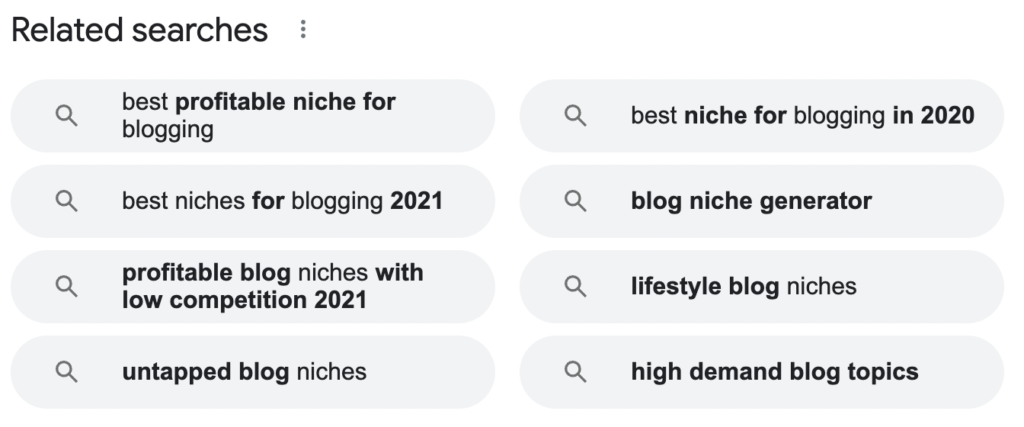
You can use these related searches to find long-tail keywords that are easier to rank for on google. You can also use these related search terms to write about in your blog post if they are relevant to the blog post, as they can help you rank higher.
If a keyword is included in the related searches section, it implies that people are searching for it. As a result, you should write on the subject.
4. People Also Ask section on Google
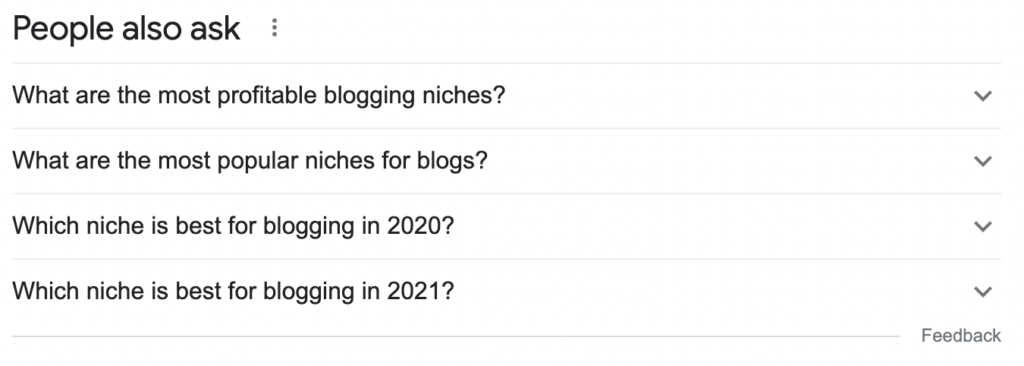
This part of google search will not only provide you with content for a blog post; it will also allow you to discover additional questions that may be used to create subheadings for your post.
This makes writing a lot easier, allowing your thoughts to flow as you write under each subheading.
It also adds value to the response you’ll be able to give by adding other questions that individuals are asking in relation to the query you presented.
5. Answer Socrates

Answer Socrates is a gold mine for generating fantastic blog post ideas. It’s a free keyword tool that generates all of the questions that have been asked in connection with your planned blog article.
It will provide you with questions that have previously been asked relevant to your blog niche, such as “How,” “Where,” “What,” “Who,” and so on.
I decided to mess around with this keyword research tool, and it didn’t disappoint.
It gave me all the questions everybody’s asked in relation to the keyword term and also provided queries that included prepositions for that same keyword.
With this tool at your disposal, you may generate blog post ideas for all niches.
6. Google Search Console
The queries section of the Google Search Console shows you keywords that visitors use to get to your website.
Google Search Console gives you the precise data for every term used to arrive on a blog, and this isn’t provided by any other third-party app.
Login to your Search Console account to see if what I’m saying here is true.
- Click on the menu icon in the top left.
- Click on performance.
Scroll to the bottom of the performance page.
You’ll notice queries made by visitors to either give you impressions or clicks.
To figure out the search volume for keyword queries, look at the impressions from the keywords.
You may either use the keyword information you have to modify the posts/pages they visit or develop a new blog post around that search query and link from the old post to the new one.
Search console is such an underused keyword tool.
7. Google Analytics
Google analytics can also assist you in generating blog post ideas, much like Google Search console.
By now, I’m sure you’re cringing at how obsessed with Google I am.
That’s not to say you’re a hater.
But, let’s be honest; they provide excellent services to assist you manage your online work more efficiently.
You can utilize topics that bring you the most traffic from various platforms to produce additional blog entries on that topic.
To do this, look at the most popular posts on organic searches, social media sites like Facebook and Pinterest to produce more content on that topic.
To evaluate popular blog articles on your site, follow these steps.
- Click on acquisition
- Select all traffic > overview
- Click on traffic sources and check out the most popular blog entries on your site.
- Change the date range to the last three months.
This technique might inspire you to come up with more blog post ideas.
8. Keyword Research Tools
One of the most effective methods to come up with hundreds of thousands of blog post concepts is with keyword research tools.
There are several keyword research tools on the internet that you may utilize to come up with your next excellent blog post topic.
I like Ahrefs for paid keyword research. It’s a wonderful keyword exploration tool that may provide you with a slew of content topics to write about.
On the other hand, there are several keyword tools that are free and can be used at any time.
When using a keyword tool to get a content idea, keep an eye on the keyword difficulty, search volume, and sites that are ranking highly for that topic.
You can use a keyword tool like Ubersuggest to get free limited daily searches.

It comprises a filter part, which you may utilize to remove the chaff from the good ones.
You may select the sort of search volume you want to see and the level of difficulty you would like to deal with.
The monthly search volume for a keyword should be greater than 100.
You may set the keyword difficulty (KD) between 1 and 30, or however far you want it.
Using these filter methods may help you narrow down the many keyword possibilities that you’ll get from these keyword tools.
9. How generate blog post ideas from Pinterest
Do you want to produce material that your target audience is interested in right now? You’ll need to utilize Pinterest Trends. Pinterest Trends is jam-packed with blog article suggestions, some of which are currently popular and trending.
Let me give you an example
When you go on to Pinterest Trends, you’ll find a page full of popular topics in various niches:

This is ideal for a lifestyle blogger that covers a wide range of topics. However, you may need ideas for a narrower blog topic/niche.
In the search box, type in your topic (make it broad). Pinterest will display different ideas connected to your search query before you search. Instead of looking for a broad topic, choose one of the suggested topics below.

When you look up anything, Pinterest will show you how the topic is evolving over time as well as other related suggestions, AND various sorts of material that are doing well within the category.
10. Google Trends
What’s better than discovering popular topics and writing about them?
Google Trends can tell you what’s currently trending in your niche. You may insert in your niche blog topic and see whether the trend for that subject is decreasing or rising.
At the bottom of each page, you’ll find a list of topics and questions that are being searched for in your niche.
When you notice a relevant topic that is marked as breakout, it implies that it is popular and trending.
I looked up the term “self care” and found that it had about 48 different topics and queries trending in the related topics and answers.

The primary topics of self-care were breakout topics, which means they are excellent topics to write about.
Another feature I appreciate about Google Trends is the ability to do a comparison of subjects to see which trends perform better. This knowledge will assist you in determining what to write about.
I decided to mess around with three personal development keywords in order to see which one is rising.
The keywords were “self care,” “self improvement,” and “self confidence.” Self care had the most topics trending, with self improvement and self confidence second and third. Probably because of the current season.
It had a total of 9 topics that were breakouts, which are topics worth writing about.
To compare subjects, click the + sign and type in the other keywords you wish to compare.
To alter the time period for trending keywords, you can also use the filter button.
It doesn’t matter how many articles you write, there will always be some that stand out above the rest. The one that received the most likes and shares.
Use your competitors’ most popular pieces of content to influence your next blog posts. You can use Buzzsumo to see what their audience liked. Simply type in the URL of your competition into the search bar.
Then, after you’ve decided on the topic and what should be said about it, adapt their content suggestions and create your own version of it with a different title.
This is a fantastic approach to come up with excellent blog article suggestions that will help you increase your social media shares.
“But I’m not sure who my competition is,” you might be thinking. You can use Google to discover that information; simply search for websites with the main keywords associated with your topic or niche.
12. Amazon Look inside
I got this idea from Neil Patel. What you’ll do is go to Amazon and search for a generic niche topic.
For example, I plugged “keto recipes” into the search. Then, I scrolled down the top results.
If you see a ‘look inside’ graphic on the book cover, it indicates that you can read a sample from the book.

It’s not necessary to read the book. The preview’s table of contents is what we’ll be focusing on.
In the table of contents in this keto recipes book, these are some of the themes that keto blogs may cover.
Some of the topics in the book’s table of contents were:
- What is keto diet
- Keto smoothies
- Meatless meals for keto diet
- Keto breakfast and dinners
- And plenty more to write on.
Before you start writing a blog post on it, make sure that you have a good chance of ranking for the keyword term.
Final Thoughts
The methods mentioned in this article can help you create blog post ideas quickly. If you’re struggling to come up with content for your website, try incorporating some of the techniques mentioned above into your strategy.
You may find that they are able to offer a boost in traffic and increase conversion rates on your site because visitors will be getting what they want when they visit – value-driven content.