
Creating an amateur blog is a great way to share your thoughts and ideas with the world. Blogging is a great way to connect with others who share your interests. It can also be a great way to connect with potential customers or clients.
Blogging can be a fun and rewarding experience, whether you’re doing it for fun or for business. If you’re new to blogging, here is my guide to help you get started.
What is Amateur Blogging?
Amateur blogging is a form of blogging that is done by everyday people, as opposed to professional bloggers. Amateur bloggers may not have as much experience or knowledge when it comes to blogging, but that doesn’t mean they can’t create great content. In fact, many amateur bloggers find that blogging is a great way to share their thoughts, ideas, and experiences with the world.
Why Start Amateur Blogging?
There are many reasons why someone might want to start amateur blogging. Maybe you have a passion for a particular topic and you want to share your thoughts and ideas with others. Or maybe you want to document your everyday life or thoughts and feelings. Whatever your reason, amateur blogging can be a great way to connect with others and share your voice with the world.
How Do Amateurs Make Money From Blogging?
Amateur bloggers can make money in a variety of ways, including through advertising, affiliate marketing, and sponsorships. Advertising is the most common way for amateur bloggers to make money. Advertisers pay bloggers to place ads on their websites or blog posts.
Affiliate marketing is a process where bloggers promote products or services on their website or blog and receive a commission when someone clicks on the link and makes a purchase. Sponsorships are another way amateur bloggers can make money. Sponsors pay bloggers to promote their products or services on their website or blog.
What Topics Are Most Appropriate for an Amateur Blog?
Amateur bloggers often make the mistake of writing about topics they know nothing about simply because they think it will make their blog more popular. However, readers can quickly tell when a writer is not passionate about their subject matter, and they are likely to lose interest in the blog as a result.
It is far better to write about topics that the blogger is passionate about and has plenty of knowledge to share. This way, the content will be full of energy and vitality, and readers will be more likely to stick around until the end.
In addition, blogging about things the writer loves will make the process more enjoyable for the writer, which will show through in the quality of their work. Therefore, when it comes to amateur blogging, it is always best to write about what the blogger loves thinking about.
How to Become an Amateur Blogger?

It’s true, that starting a blog is easy. You don’t need to be a born writer or have amazing grammar. You can just start writing and putting words on (digital) paper.
However, the real question is: should you post your content on a free platform or on a self-hosted WordPress? If you’re looking to build an audience and make money from your blog, then self-hosting is the way to go.
With a self-hosted WordPress blog, you’ll have more control over your content, branding, and monetization options. Not to mention, self-hosted blogs tend to rank higher in search engines. So, if you’re serious about blogging, self-hosting is the way to go.
Free Blogging Platforms Pros and Cons
Pros
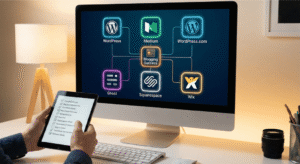
- There are a variety of free blogging platforms to choose from (WordPress.com, Tumblr, Blogspot, Wix, Medium, Weebly, Squarespace, and Shopify…)
- It’s easy to begin
- You can host your material for free
- Those platforms are simple to use
Cons
- Your content is not under your control – it can be deleted at any time without your input
- There are no customization options available, and your blog will look bland at worst.
- Self-hosting WordPress might prove difficult later on.
Paid Blogging Platforms Pros and Cons (Self Hosted WordPress)
Pros:
- Self-hosted WordPress blogs offer more control over your content, branding, and monetization options.
- Self-hosted blogs tend to rank higher in search engines.
- You can customize your blog however you want, and there are no restrictions on what you can post.
- You can make money through a variety of methods, including advertising, affiliate marketing, sponsorships, and selling products and services.
Cons:
- You have to pay for hosting, which can be expensive if you’re just starting out.
- There is a learning curve involved in setting up and maintaining a self-hosted WordPress blog.
- If you don’t monetize your blog, it probably won’t make you any money.
Overall, self-hosting is the best option for amateur bloggers who want to make money from their blogs. While there is a learning curve involved, the benefits far outweigh the cons.
Amateur Blogging Tips
It’s possible to create a successful blog as an amateur, but you must remember the fundamentals. Follow the guidelines below to get excellent results with your amateur blog quickly.
Writing Posts – Write posts that are at least 1000 words long. Longer posts tend to rank higher in search engines and get more social media shares.
Do Keyword Research – Use keyword research to find out what people are searching for online. Then, write blog posts that target those keywords. This will help you get more traffic from search engines.
Do your research – Spend time researching your topics before you write about them. This will help you write more authoritative and comprehensive posts.
Edit your work – Take the time to edit your posts before you hit publish. This will make sure that your readers see your best work.
Use images – People are visual creatures, so use images in your posts to break up the text and add visual interest.
Share your posts – Once you hit publish, share your posts on social media and with your email list. This will help you get more traffic to your blog.
Engage with other bloggers – One of the best ways to grow your blog is to engage with other bloggers in your niche. Comment on their posts, share their work and collaborate with them when you can.
Have an Attractive Headline – Headlines are the first thing people see when they find your blog post. Make sure your headlines are attention-grabbing and make people want to read your posts.
Constant Posting – One of the keys to success in blogging is consistency. Try to post new content on your blog at least 2-3 times a week. This will help you attract and retain readers.
Be Concise – No one wants to read a long, rambling blog post. Get to the point and be concise in your writing.
Be Original – Write original content that is interesting and informative. Don’t just regurgitate what others have already said.
Be Passionate – Write about topics that you are passionate about. This will make your writing more engaging and enjoyable to read.
Keep it Simple – Use simple language that everyone can understand. Avoid using jargon or technical terms unless you are writing for a specific audience.
Be Yourself – Be yourself and let your personality shine through in your writing. This will make you more relatable and approachable to your readers.
Do SEO – Focus on the fundamentals and utilize keyword terms that you want to rank for liberally in your articles. I use RankMath, but Yoast is also great. These two easy procedures can help you make your articles SEO-friendly and increase organic traffic significantly.
Note: These SEO plugins are free plugins that may only be used on self-hosted WordPress and not on free blogging platforms.
Have Fun – Blogging should be fun, so make sure you enjoy the process. Otherwise, it will show in your writing.
These tips will help you blog like a pro, even if you’re just starting out. Follow them and you’ll be well on your way to success.
How To Start an Amateur Blog With Bluehost and WordPress (Tutorial)
There’s an easy rinse-and-repeat formula I use for starting a blog. Here it is:
- Pick a Niche
- Name Your Blog
- Get hosting and domain
- Add WordPress
- Design it, add content
- Publish and launch to the public!
1. Picking a Blog Niche/Topic
The blog niche is the blog’s topic. What are you going to blog about?
You should niche it down a bit, and blog about something in a specific niche, check out these ideas to give you some inspiration:
- Fitness
- Food
- Travel
- Pets
- Beauty
- Finance
- Tech
- Home Decor
- Fashion
- Parenting
- DIY/Crafts
- Lifestyle
Within any of these niches you should niche down, even more, this will help you rank in Google when you’re first starting out. Once your blog starts ranking on google you can then start branching further out within your niche.
Next, it’s time to name your blog.
2. Naming Your Blog
This is such a breeze and you shouldn’t overthink your blog name.
- A catchy name.
- A memorable name.
- A meaningful name.
- A play on words.
My First Blog Name I Picked Out In Like 20 Minutes.
Then 2 months later I wanted to change it. I grew bored of the name but didn’t change it.
In Under A Year I Was Making Four Figures Per Month.
The truth is, the name didn’t matter. It didn’t prevent me from earning tens of thousands of dollars with that first blog and it has not stopped me from becoming a full-time blogger.
I will share some tips to help you with the name.
Here they are:
- Try to have your blog and domain name match. For example, Beautiful Travels should be at beautifultravels.com for example. Aim to have the two-match as closely as possible.
- Go for .com
- Don’t misspell words or use slang in your name or domain
- No hyphens, no numbers, exclamation points, or special characters
There. Now it’s time to name your blog!
3. Getting Hosting and Domain Name For Your Amateur Blog
Your Hosting plan and Domain can be scooped up from this host.
You purchase hosting and get the domain name (plus other cool perks) for FREE!
I usually pick the basic or middle plan for my websites.
To Start, Click This Link To Open Bluehost Hosting In A Separate Window.
This Way You Can Look At The Instructions And Signup For Hosting Side By Side, To Make It Easy.
You’ll land on a page that looks like this.
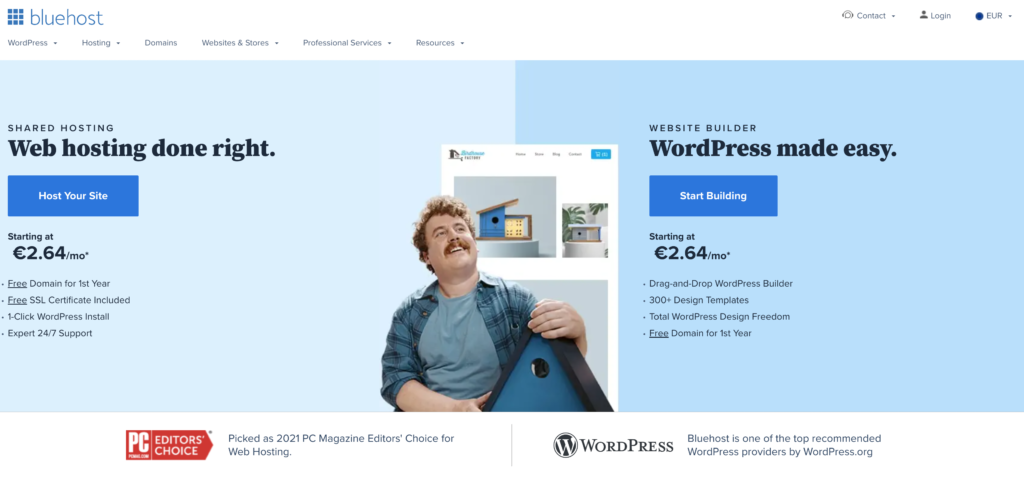
Next you’ll see a page that looks like this.
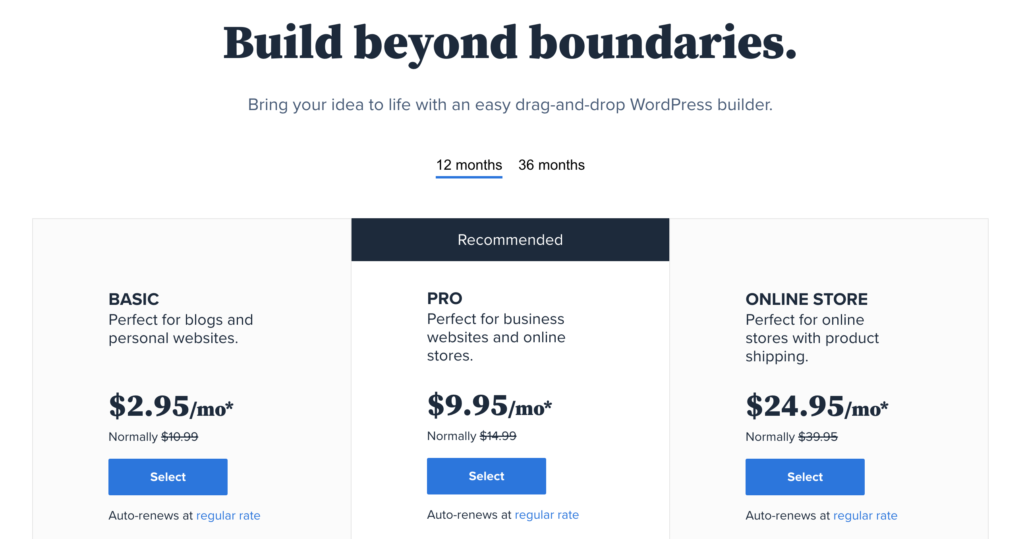
Select the ‘Basic’ Plan, unless you want an online shop or Domain Privacy, then I would recommend ‘Pro’. Normally the Basic plan is $10.99/month, but you can get it now for just $2.95 per month, so scoop it up before the price changes!
After Selecting Your Plan, You’ll Be Taken To This Page.
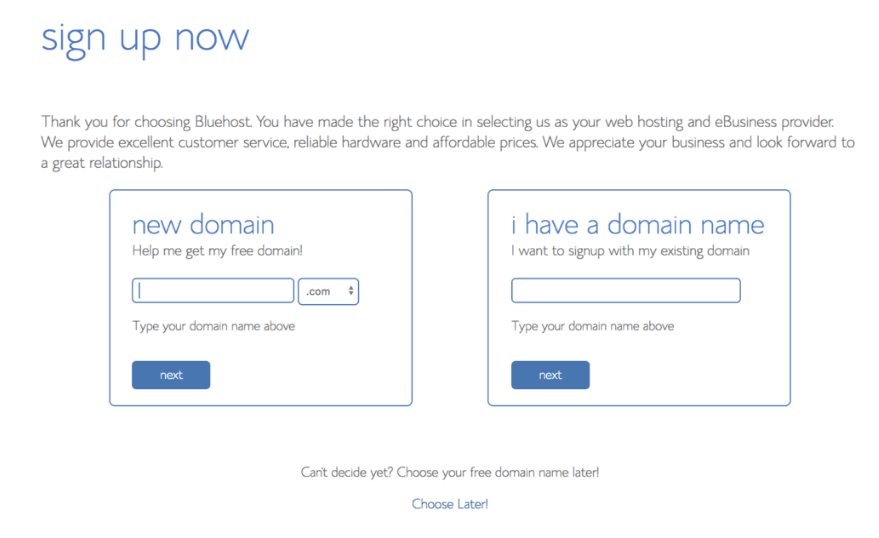
New Domain: If You Have A Domain Name You Have Chosen, You Will Select The “New Domain” Option
I Have A Domain Name: If You Have Purchased Your Domain Separately Already, You Will Select The “I Have A Domain Name Option”
Then, Create Your Account And Fill Out The Appropriate Fields.
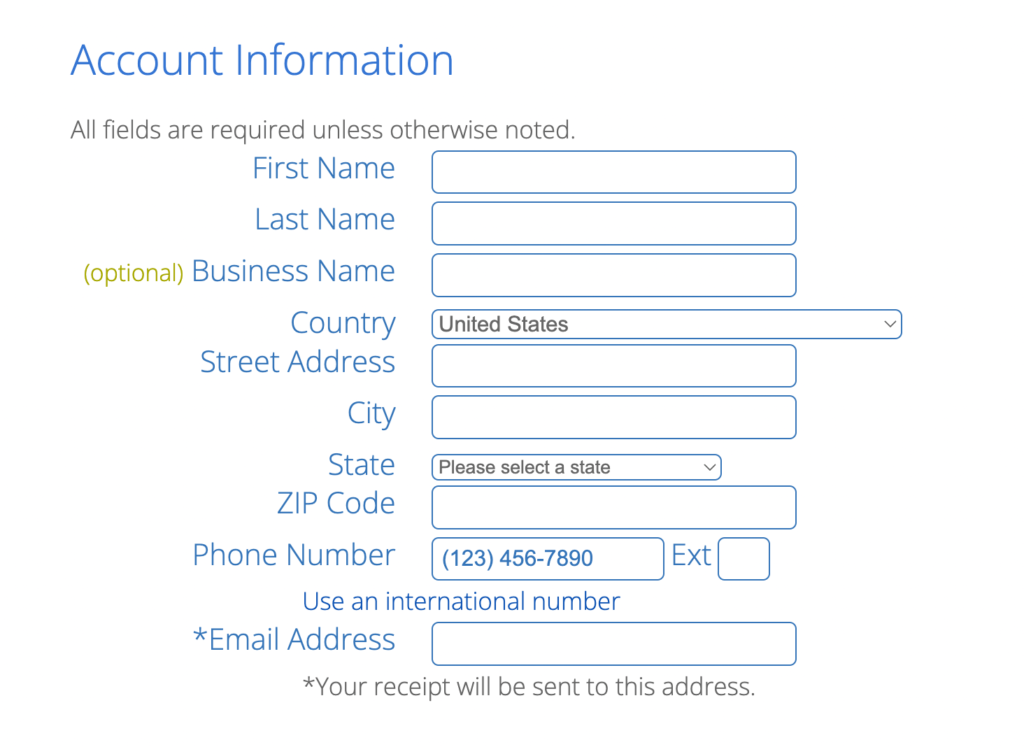
You can sign up for 12 – 36 months plan.
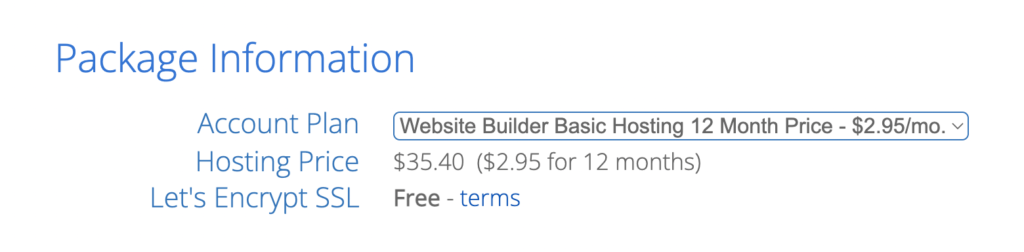
I recommend the 36-month option because it saves you the most money but if you want to do 12 months, that is totally fine too. Do you need package extras?
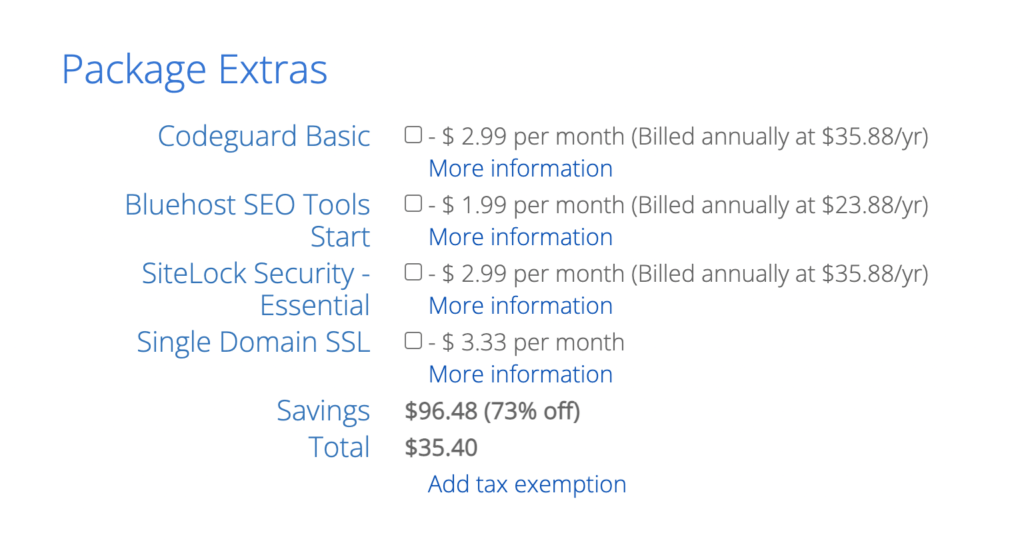
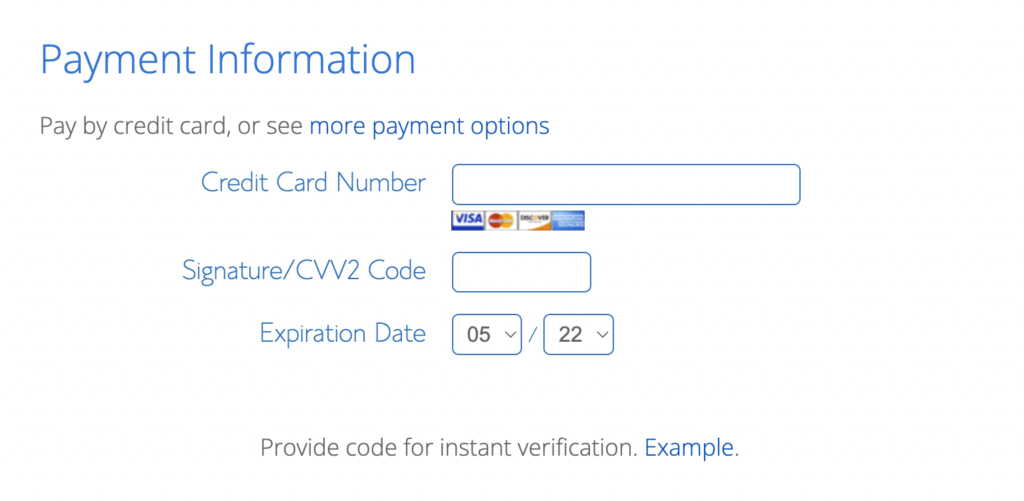
Next, You’ll Pay And Complete Your Setup.
Congratulations, You Did It!
If you want more help you can check out the How to Start a Blog page or join the how to start a blog e-course by filling out the form below.
ENTER YOUR EMAIL HERE TO JOIN THE FREE HOW TO START A BLOG E-COURSE
4. Add WordPress With The 1-Click Install
Bluehost Has A Super Simple 1-Click WordPress Install Which Adds WordPress To Your Account For You.
This is your blog platform so you want this, and it’s also totally FREE. WordPress will be where you write your article, add media and photos, and manage your entire blog.
5. Design And Content
Design is where you can let your creative juices flow and you can really make your blog shine.
This process is TOTALLY fun.
This is where you will apply a WordPress theme and make your blog look good.
Content is the meat and potatoes of your blog. It’s going to be your blog pages like:
- About
- Contact
- Resources
- FAQ
- Privacy Policy
- Terms and Conditions
And your blog posts, of course.
6. Launch Your Amateur Blog
When to launch your blog?
I recommend launching when you have at least 5 to 20 blog posts written and ready for publishing.
This will give a good, solid base for your blog so visitors will have a nice selection of pages and posts to look at when they land on your blog.
YOU CREATED YOUR BLOG, GOOD WORK!
The Backbone of Successful Amateur Blogging Is Quality Content
Now that you have a domain name and hosting, it’s time to start creating content. Quality content is the backbone of successful amateur blogging.
When you are starting out, it’s important to post regularly. Aim for at least one blog post per week. As your blog grows, you can post more frequently. Two to three times per week is a good goal to aim for.
When you are first starting out, it’s important to write about topics that you are passionate about. Your passion will shine through in your writing and make your content more enjoyable to read.
As you become more experienced, you can branch out and write about other topics that you are interested in.
Do some research on popular keywords that people are searching for and write blog posts accordingly. This will help you to draw more traffic to your blog.
Always proofread your content before you hit publish. No one is perfect and everyone makes mistakes but it’s important to catch them before your readers do.
Use spell check and grammar check to help you spot any errors. If possible, have someone else read over your content before you publish it. Another set of eyes can often catch errors that you may have missed.
Amateur Blogging Mistakes- Avoid These!
- Don’t Start a blog on a free platform – There are many free blog platforms out there but they come with several disadvantages. One of the biggest is that you will have limited control over your blog. You won’t be able to customize it the way you want and it will be harder to monetize. It’s best to start off on a self-hosted platform like WordPress from the beginning.
- Don’t Choose a niche you’re not passionate about, or you know nothing about – This is a surefire way to kill your motivation and your blog. If you’re not passionate about your topic, it will be hard to keep writing about it week after week. It’s also important to choose a niche that you know something about. This way, you can provide valuable insights to your readers.
- Don’t copy other bloggers – This is a surefire way to lose readers. Be original and share your own unique voice with the world.
- Don’t neglect promotion – If you want people to read your blog, you need to let them know it exists! Share your posts on social media and forums, and encourage your friends and family to check it out.
- Don’t get discouraged – Blogging can be a lot of work, but it’s also a lot of fun. Stick with it and you’ll be sure to see success!
- Don’t forget to do SEO (Search Engine Optimization) – One important thing to remember when starting a blog is to do SEO (Search Engine Optimization). This will help you attract more readers over time. Check out our tutorial on SEO Tips for Bloggers.
- Don’t forget to blog regularly – Another important thing to remember is to blog regularly. This doesn’t mean you have to post every day, but you should try to post at least 3-4 times a week. Consistency is key when it comes to blogging
Amateur Blogging FAQ
Is Amateur Blogging Worth it?
Yes absolutely, I started blogging 3 years ago as a total amateur and within the first year I was making four figures per month and I’m now a full-time blogger.
Can an Amateur Blogger Become a Pro Some Day?
Yes, definitely! If you have the dedication and put in the hard work, you can become a professional blogger. I started out as an amateur blogger and now I’m a full-time blogger. It takes a lot of effort, but it’s definitely worth it in the end.
Can I Create a Blog on a Free Platform and Then Upgrade Later?
It’s not recommended to start out on a free platform because it’s much harder to transfer your content later on. It’s better to start out on a paid platform like WordPress.org from the beginning.
How Much Time Does Amateur Blogging Take?
I would say that on average, it takes about 3-4 hours per week. It really depends on how often you blog and how much time you put into each post.
How Much Money Can I Make Amateur Blogging?
On average, you can make $500-$1000 per month. It really depends on how often you blog and how much time you put into each post.
Is My Niche Overcrowded?
If there are a lot of other bloggers in your niche, it might be more difficult to make money and get traffic. However, if you have a unique angle or voice, you can still succeed as an amateur blogger.
Conclusion of My Guide to Amateur Blogging
So, if you’re looking to start a blog as an amateur blogger, these tips will help get you started on the right foot. Remember to focus on quality content, and make sure your blog is easy to navigate for your visitors.
And lastly, don’t forget to have fun! Blogging should be enjoyable, so make sure you enjoy the process. Thanks for reading and good luck!